Rockland, Maine is a working town of a little over 7,000 people on the western shore of Penobscot Bay. Lobster boats, a granite breakwater, a ferry terminal, and — improbably, or maybe not — one of the densest concentrations of serious art in New England. The Farnsworth Art Museum is here. So is the Center for Maine Contemporary Art. And as of this summer, so is a brand-new artist residency campus that I think every artist reading this should know about: the Ellis-Beauregard Foundation.
I've been writing about residencies long enough to be wary of a good origin story. The field is full of beautiful mission statements attached to programs that quietly charge you $50 to apply, host you in a room they oversold, and hand you a tote bag instead of the support they promised. So when a residency opens with almost no fanfare, funds the artists it accepts, and builds — from the ground up — exactly the rooms artists actually need, it's worth stopping to look closely.
The founders bought a slower life, then gave it away
The foundation carries two names because it carries two artists. John David Ellis and Joan Beauregard traded their Lower East Side loft studios for the coast of Maine in the late 1970s — the classic downshift, more space and less noise, in a town where a painter could actually afford to work. The house they built in Rockland now holds the foundation's offices and archives. The foundation exists to do three things at once: provide real resources to artists, engage the surrounding community, and sustain the legacy of the two people who started it. That third goal is the one most funders forget to name, and it's the one that keeps a place honest.
The residency program isn't new — earlier cohorts worked out of the Lincoln Street School in town — but it went on hiatus in 2023. What came back in 2026 is different in one very big way: the artists now live and work on a purpose-built campus, not far from downtown, designed for them from scratch.
What they actually built
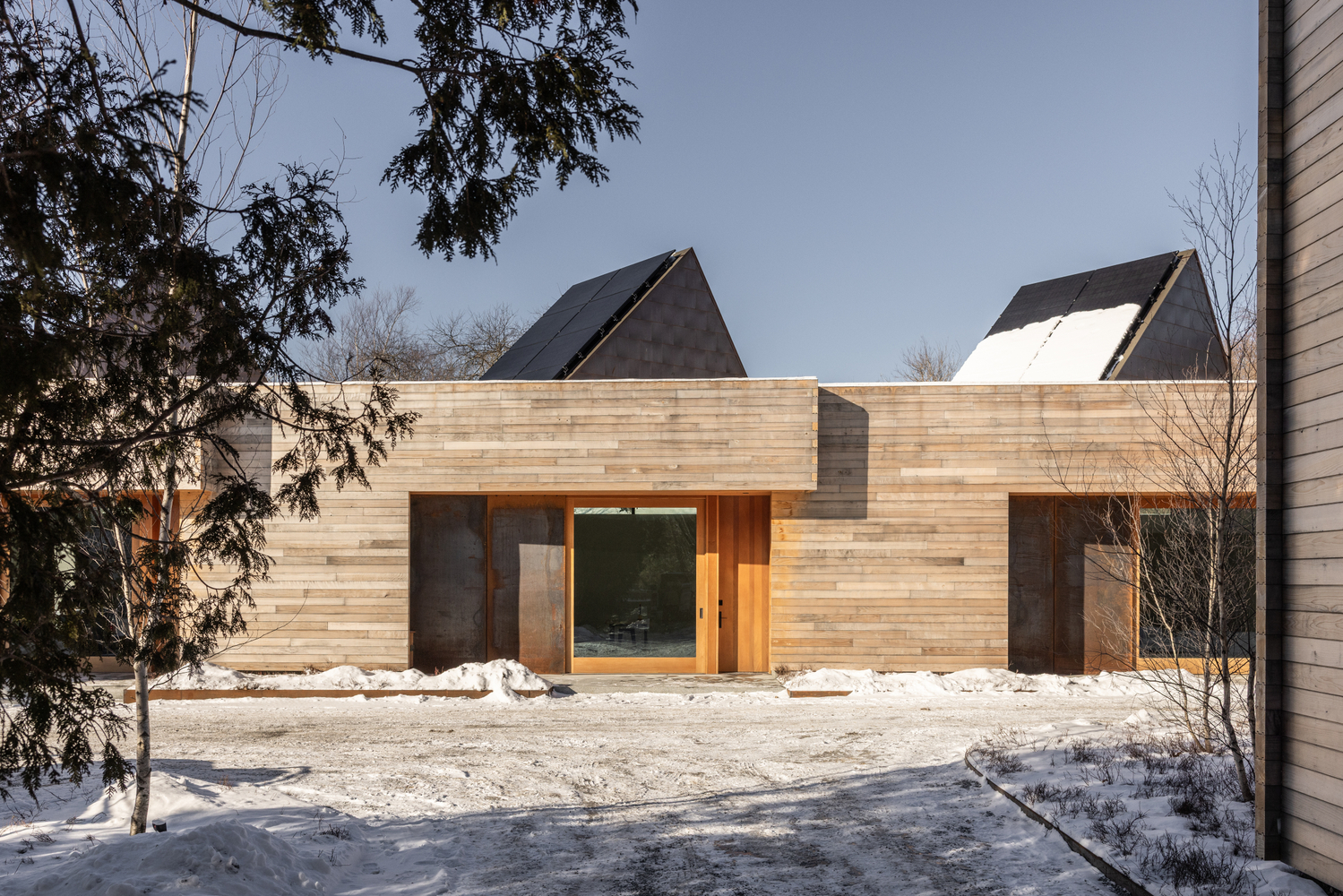
Here is the part that made me sit up. Working with Baird Architects, the foundation put up two custom structures and unveiled them at a celebration at the end of June. One is a long, straight building that houses four artists — living space and studio both. The other is an L-shaped exhibition and performance hall.
The studios are the tell. Each is 20 by 20 feet, with a north-facing skylight, gallery lighting, sound reduction, superior ventilation, reinforced walls (hang something heavy — go ahead), a slop sink, and real storage. Attached to each studio is a private apartment: a separate bedroom with a built-in desk, a double bed, a closet, and a full bath with a tile-and-glass shower under a transom window. A shared common room with a kitchen, a dining area, and an oversized Rumford fireplace ties the four residents together without forcing them into each other's practice. The performance and exhibition space next door has a sprung floor, acoustic panels, projection, gallery lighting, and seating for 50.
Read that list again as an artist and you'll notice something: every single item on it solves a problem you've actually had at a residency. North light you can't control. A studio you can't hang work in. A "shared kitchen" that's a hot plate in a hallway. Nowhere to show the thing you made when the month is up. Someone who has spent time as a resident designed this, not someone who has spent time on a donor tour.
The number that matters: what it costs you
RMAR exists in large part because artists chronically underestimate what a residency costs them — we've documented artists spending thousands out of pocket on a "free" residency. So we always run the money first.
At Ellis-Beauregard, accepted residents receive free studio space, free living space, and a $2,000-per-month stipend. Sessions run one or two months, with six sessions offered across the year at the juror's discretion. Eligibility is open to U.S. citizens and lawful permanent residents who are at least 18. Applications are juried through the foundation's Submittable portal — check it for the current cycle's dates, since recent residency deadlines have landed in late fall with decisions by January.
A stipend is not a small thing. Plenty of well-regarded residencies cover housing and studio and then leave you to absorb the lost income of taking a month off work. A program that hands you $2,000 a month is a program that has thought about the artist's actual balance sheet — the rent that doesn't pause at home, the shifts you're not picking up. That's the difference between a residency you can accept and a residency you can only admire.
Why we're putting it on the map now
This has been a strange season for residency news. Some of the loudest stories this summer were about a program accused of overselling its capacity and charging application fees against vague promises — the kind of episode that makes artists rightly suspicious of any glossy opening. The Ellis-Beauregard campus is the counter-example, and it deserves to be read as one: no scramble for press, no upsell, no ambiguity about who pays whom. Four artists, four excellent studios, a stipend, and a room to show the work.
That's the whole RMAR thesis in one small building on the Maine coast. The programs worth your application aren't the ones with the best marketing — they're the ones whose facts hold up when you check them. Location: verifiable. Funding: stated plainly. Facilities: built for the work. Reputation: earned in a town that has quietly been one of the most culturally alive places in the Northeast for years.
So we've added the Ellis-Beauregard Foundation to the RMAR directory. If you've been in residence there — in the new studios or back in the Lincoln Street School days — leave a review. The next artist deciding whether to spend a Maine winter making work in a 20-foot room under a north skylight will want to hear it from you, not from us.
Sources
- Cultured Magazine, "This New and Improved Residency Program in Maine Is the Art World's Best-Kept Secret" (June 26, 2026) — culturedmag.com
- Baird Architects, Ellis-Beauregard Foundation project — bairdarchitects.com
- Artist Communities Alliance directory, Ellis-Beauregard Foundation Artist Resident Program — artistcommunities.org
- Ellis-Beauregard Foundation, Residency & application — ellis-beauregardfoundation.org